



 For many years, mathematicians avoided using or thinking about the square root of negative numbers. Preferring to think in terms of real numbers, they simply agreed with each other that roots of negative numbers made no sense at all (for similar reasons, negative numbers were avoided for many centuries). After all, there is no physical length that can possibly equal such a number. What possible use or relevance could it have for our world?
The Italian mathematician Gerolamo Cardano (1501-1576) was the first to have explored complex numbers seriously. He used them in order to find solutions to cubic equations … and called them “fictitious.” Little did he realise what an incredible explosion of understanding would result from his first foray into this field!
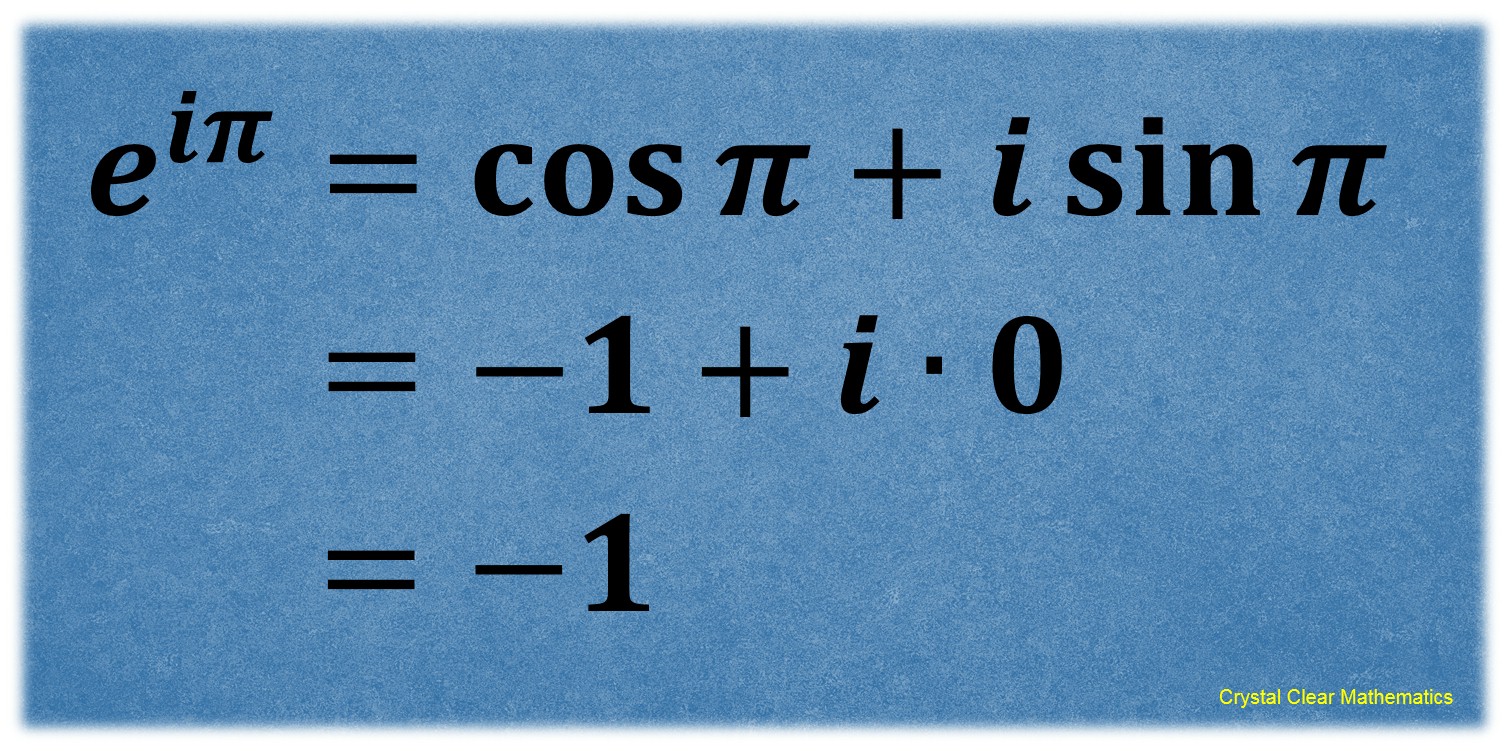
It transpires that complex numbers are intimately connected with exponential equations and with trigonometry (see the image to the left, where i represents √(-1) and is called an “imaginary number”).
Nowadays, complex numbers are used whenever any repetitive, cyclic, or wave motion is being analysed (from star light to quantum mechanics to electric tuning circuits to shock waves during earthquakes)! Not only do mathematicians study them for the pure joy (and fascination) of the exercise, but they are used in many disciplines such as physics, chemistry, biology, engineering, statistics and economics.
Briefly, an imaginary number is one that is obtained by taking the square root of a negative number. If we define √(-1) as i (meaning imaginary), all imaginary numbers can be written as the product of i and some real number. This is because √(-k) = √(-1)⋅√k = i√k, where √k is real.
Complex numbers are hybrid numbers, obtained when we add a real number and an imaginary number together … such as 2 + 3i.
There is much, much more … so, watch this space!
Our boys received a distance education and required additional tuition in their higher level of Maths. Graeme undertook this for us which brought together both his professional expertise and the motivation required for our boys to achieve the excellent results that we all hoped for. Today our boys are following their chosen career paths and we will always remain grateful for Graeme’s part in that. We warmly commend Graeme’s tuition and dedication to his students to you.
David and Mary T (parents, c2006-2012)
See all Testimonials


